

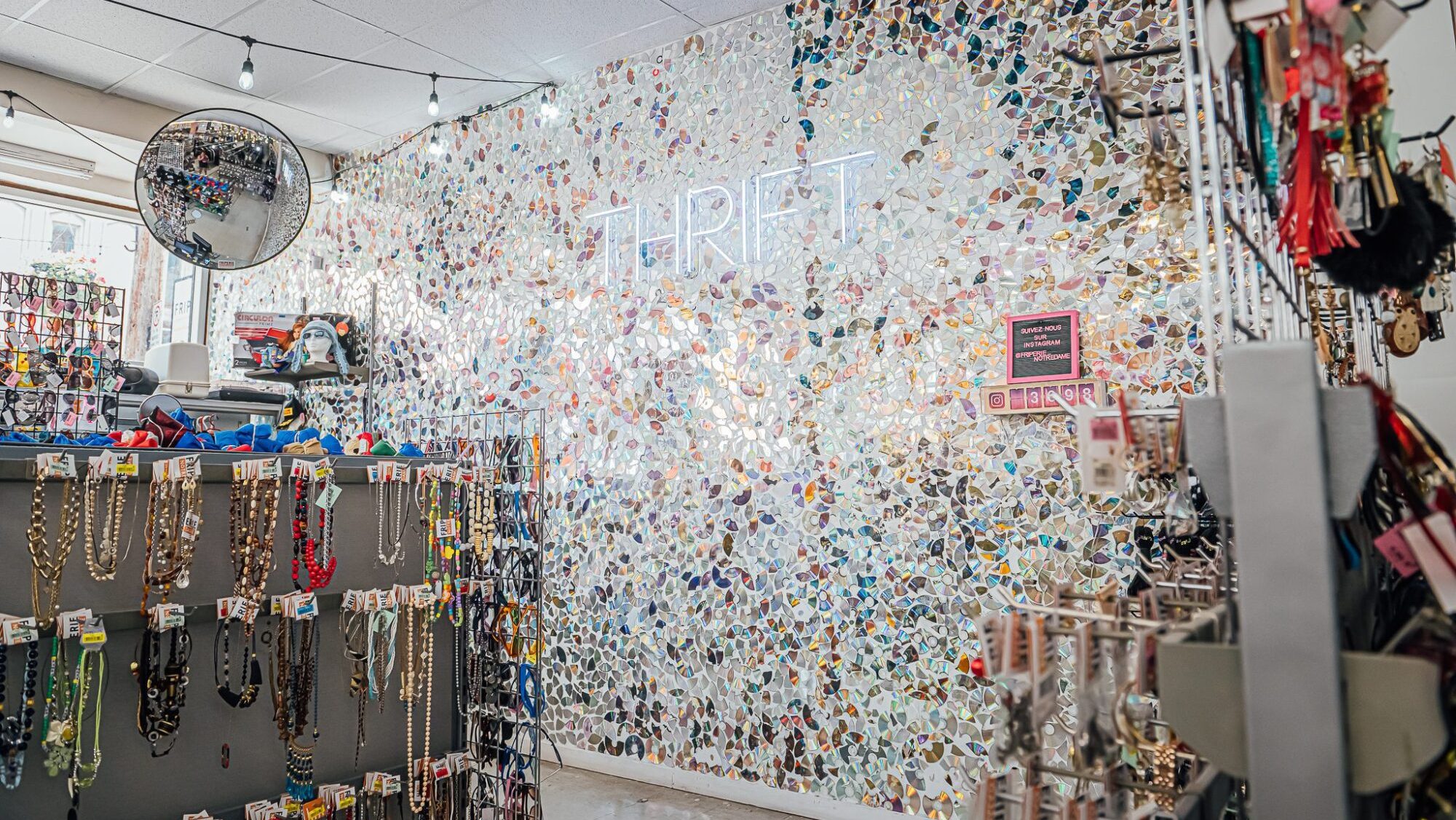
What comes to mind when someone says thrift store? Is it a dark church basement, with junk piled floor to ceiling. If that’s the case, we’re about to show you that not all thrift stores are created equal: quite the opposite. Friperie Notre-Dame breaks all the rules when it comes to shopping second hand.
How it started
Andrew Harriott and Chloé Boudreau, the owners of Friperie Notre-Dame, share the dual passions of thrifting and travel. Andrew is originally from Newcastle, a small British city in northeast England. Andrew wanted to find himself and see the world, so he hit the road and ended up in Canada, hitchhiking across the country from British Columbia to Newfoundland.
That’s a lot of kilometres! Andrew relished every landscape and every encounter, and he wanted to keep exploring. As he was heading to Quebec, a good Samaritan who picked him up told him that if he wanted to learn French, he should go to Saguenay‒Lac-Saint-Jean.
So, Andrew headed to this beautiful region, landing a job in a trucking company. The beauty of immersion is that it’s a fast track to learning a second language.
Andrew worked for the company for around six months before hitting the road again, certain about one thing: he loved Quebec.
Then he met the woman who stole his heart: Chloé Boudreau.
Growing up in Lachine, Chloé understood early on that travel broadens the mind. Curious and open by nature, she wanted to travel before continuing university and starting a career. She left the family fold and set off for adventure. Discoveries, hitchhiking, encounters, tours and awe were part of her life for months, to her great delight.
When her eyes first met Andrew’s, the chemistry was undeniable. Sharing common values, areas of interest and experiences, Chloé and Andrew saw themselves in each other, fell under each other’s spell and became inseparable.
Vibrant and courageous, the couple set off on a great adventure and travelled Canada, Europe and Africa, packs on their backs, smiles on their faces and joy in their hearts.
Taking work on farms and in hotels, bars, restaurants and then some, the young couple amassed experience that gave them the money they needed to continue their adventure.
One of the many things Andrew and Chloé share is their love of thrift stores. It’s a passion. The couple even set the challenge of finding thrift stores in every city they visited, until their return to Quebec.
To Quebec? You bet! Andrew and Chloé chose to settle in la belle province. Andrew had fallen in love not just with Chloé, but also with Quebec and the French language.
Trash worth its weight in gold
The backpacks were put away, at least for the time being, and it was time to plan the next part of their lives. Living in their favourite Montreal neighbourhood, NDG, the couple adopted the pace of the city and a sedentary lifestyle. Still undecided about her future, Chloé started studying sustainability and human environments, while Andrew, who didn’t yet have his permanent residency, was completing French courses.
Together for eight years, and married for six, Andrew and Chloé started their project without even realizing it, by collecting furniture and things thrown in the trash. They started with furniture. After restoring pieces, the furniture and objects were sold on well-known digital sales platforms, such as Kijiji and Marketplace.
They collected so many things that their home was filled with furniture and objects awaiting restoration; Chloé and Andrew just couldn’t keep up.
While entrepreneurship was never part of their plan, the situation got them thinking. They soon set hesitation aside and decided to make a career out of selling second-hand items.
Money: the crux of most things
First, they had to find the right space for their business. The future entrepreneurs chose Lachine as a location, because there knew the local community needed an alternative to dumps.
But it takes money to rent a commercial space. At the time, the couple had very little. Probably too little to convince a financial institution to embark on the project.
With only their courage to guide them, the couple looked around at the possibilities and found a financing program for recent immigrants. To take advantage of it, they combed through the resources available online to put together a business plan that reflected their ambitions. They met their goal and then some, because the advisor who reviewed their application for financing said that their business plan was one of the best amateur plans she’d ever received!
For the first meeting, the advisor went to their apartment. They had to demonstrate the project’s viability. In the clutter of their apartment, Andrew and Chloé had to prove beyond a doubt that their idea was a good one, that there was a market for this type of business, and, most importantly, that they could repay the loan.
“We knew nothing about business,” Chloé says. “We were just really motivated!”
Against all expectations, their loan application was approved. With the promise of financing in their back pocket, they could now sign a coveted lease for a 1700-square-foot space.
That was February 2020. The following month the COVID-19 pandemic hit, with non-essential businesses closing in its wake.
Then the other shoe dropped: the financial institution that had approved Chloé and Andrew’s loan decided to wait until their business could open to customers before disbursing the funds.
The couple found themselves on the hook for a commercial lease, with no possibility of generating revenue. This could have discouraged the most daring among us, but the budding entrepreneurs were too headstrong for that.
“We’re stubborn,” Andrew says. “We know what we want.”
Regardless of the circumstances, online sales continued and even ramped up. For a year, Chloé and Andrew even offered delivery by bike from their NDG home to their Lachine store. Their determination was such that they didn’t lose their space, or their home, and they even managed to generate a bit of income while waiting for the tides to turn for retailers.
One, two, three stores
Once they could finally open their store, Friperie Notre-Dame, the customers came out of the woodwork, and sales exceeded their expectations. They were becoming known in the community, and all sorts of objects people wanted to get rid of appeared at their door. The objects were cleaned, restored and sold at a frenetic pace, but they soon realized that the space wasn’t big enough for all the activity.
Victims of their own success, the couple had to start looking for a larger space, and they set their sights on a lovely 3000-square-foot storefront in the same neighbourhood.
At that point, Friperie Notre-Dame’s original location became a used furniture store, their new space was to sell clothing, accessories and items for adults, and, on the same street, they rented another space to sell children’s goods.
Logistically, this was an enormous amount of work. They had to sort through the donations and then get the right items to the right place. Andrew and Chloé, who were working tirelessly seven days a week, realized that they couldn’t keep up the pace for long without putting their health at risk.
Now old hands, the couple started looking for the perfect space: one big enough to handle every category of merchandise, from furniture to toys. Luck was smiling on them: they found the location, which is the current premises of Friperie Notre-Dame, and could finally catch their breath.
Great expectations
Once they were settled into their store, Andrew and Chloé worked tirelessly to learn more about the business, built a computerized inventory and tagging system and systematized their operations to make them easier to replicate in another business.
This knowledge is key for the couple, because they have more projects on the go.
The two entrepreneurs are indeed passionate about thrifting. Their goal is to burnish the image of shopping second hand. They don’t want to moralize or point the finger at society’s messages about overconsumption. They just want to show people that options exist and encourage them to consider shopping second hand. Friperie Notre-Dame, with its well-organized, attractive and uncluttered departments, looks nothing like a church basement, and makes shopping pleasant and easy.
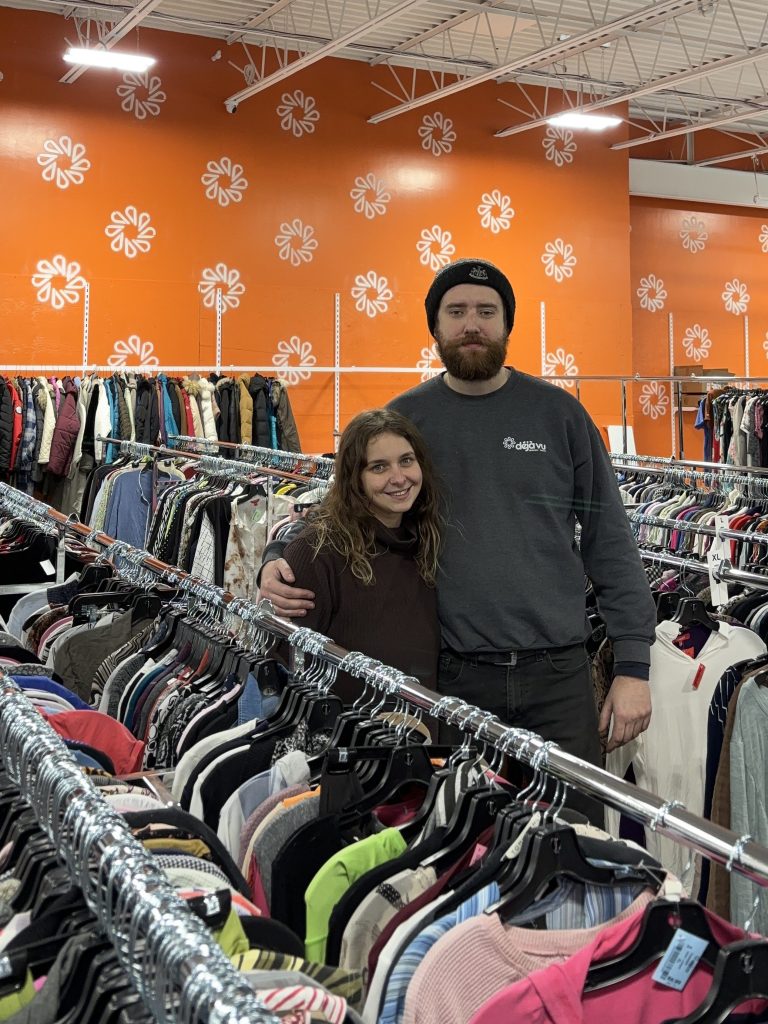
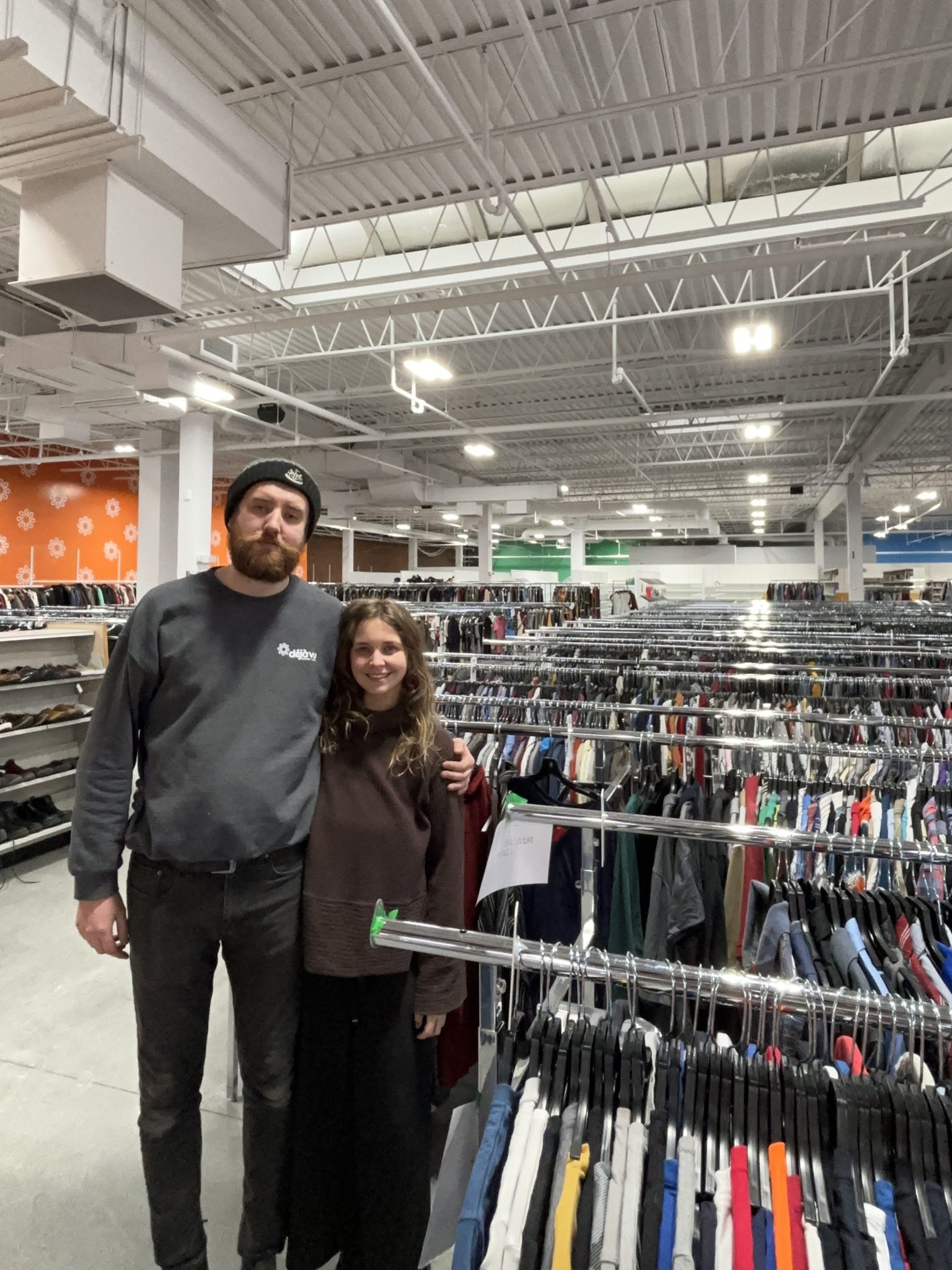
The couple is proud to be working on opening a new used goods store in NDG, their beloved Montreal neighbourhood. Their most recent baby, a 15,000-square-foot space, has been baptized Déjà Vu. With a wide range of items for sale, the store with its contemporary decor and treasures to discover, is warm and attractive. It will open in March 2025.
The couple is also looking at the possibility of offering consulting services to anyone who wants to open a thrift shop, because, having started from a blank slate, with no knowledge or experience in the area, Andrew and Chloé had to be resourceful and even a bit stubborn to open their store. If they can pave the way for future thrift store owners, they will enthusiastically share what they’ve learned.
• • • • • • • • • • •
Andrew Harriott and Chloé Boudreau appreciate the wonderful support from the Regional Director for Montreal, Sylvie Gasana. Sylvie is much more than a Regional Director. She is a stalwart ally. With her warmth and expertise, she builds trust that enables entrepreneurs to develop to their full potential. Her personalized approach and constant availability make her a role model.
Thanks to the engagement of invaluable partners: Économie Québec, through its agent Investissement Québec, the Government of Canada, National Bank, the Business Development Bank of Canada (BDC), the Fonds de solidarité FTQ, and Fondaction, Evol has a large envelope to support, through conventional loans, businesses with inclusive, diversified ownership that generate positive social and environmental impacts in line with the UN’s sustainable development goals (SDG).